


Managing a Multi-Cat Household
What is classed as a multiple cat household?
A household that has two or more cats is considered as a multiple cat household. We will try cover everything that a multiple cat household requires especially before you think about adding to the clowder (a group of cats).
Neutering/Spaying
Before you can even consider having more than one cat in the house, it is incredibly important that if you have more than one of either sex, all the male cats or all the female cats in the household are neutered before they are introduced. We just cannot over-emphasise this.
Entire, unneutered male cats (“Toms”) can father kittens from about seven to nine months of age.
Unspayed female cats (“Queens”) can reproduce from as young as four months of age, and can produce three litters of four to six kittens a year.
You cannot overcome the maths and biology.
If you have just one entire male and just one unspayed female together in the house, you will have a pregnant cat incredibly quickly. Then, approximately 9 weeks later, you will have at least four kittens to look after permanently, or to try to get adopted. If you don’t get them and the mum neutered, you could have between 8 and 28 more kittens in another couple of months. This quickly descends into a vicious circle of interbreeding, made increasingly difficult to break due to the spiralling cost of neutering so many cats.
To be brutally frank, this is why the term "multi-cat household" can have such negative connotations for cat rescues, as each has experience of suddenly having to rehome dozens of cats from horrific living conditions where interbreeding has got out of their owners' control. For example, our webmanager's tuxedo cat was rescued from a one bedroom flat along with another 22 (unneutered) cats.
Also, please don’t fall into the anthropomorphic trap. Your cat does not “need to experience motherhood” and have one litter before their spay. They will not care, despite endless schmaltzy Internet Memes of “momma cats with their one precious kitten”. Cats are not designed like humans – it’s just not how nature has made them. They don’t dote endlessly on one or two precious babies like we do. Nature programmed cats in the wild to have multiple litters of multiple kittens to ensure some survive. A thousand years of domestication hasn’t changed any of that. Cats and their kittens also pretty much lose interest in each other once they are weaned and start to fend for themselves.
In addition, unfortunately some female cats don’t accept some, or even all, of their babies, leaving you in the position of having to bottle feed every couple of hours, 24/7, for weeks…or watching a kitten deteriorate to an inevitable and heartbreaking end. Watch Kitten Lady’s video on hand rearing a kitten.
Honestly, your cats don’t need to reproduce. The world is not short of kittens. If you really do want one in your life, please go to an animal shelter and adopt one. Also, remember that they grow up really fast, so you only get a tiny furball for a few months in any case.
Of course, even if all your cats are the same gender, you still need to get all your cats neutered for the reasons detailed on our page about Neutering, but you can at least introduce them first while you arrange the appointment(s).
Does your house have enough room?
Cats like their own space - well don’t we all! It’s so important that each cat has some space to “call their own” to provide a healthy environment for your kitty. It’s a good idea to look at how much space you have in your home to determine how many cats you could realistically have. If adequate space is not given to each cat, this will create conflict and an unhappy stressful home environment.
Safe spaces
It’s essential to have lots of “safe spaces” where your get can go and hide if they are feeling scared or stressed. Also, cats love nothing more than to crash out or just chill and watch the world go by somewhere they feel secure and know that they won’t be disturbed by any predators. These might be high up spaces where cats feel more secure, such as on top of wardrobes or shelves. Thinking like a cat and popping a nice warm furry blanket where you’d want to sit, or giving them enclosed spaces like igloo beds will help your kitty to relax and feel at home. Creating lots of these in your home will give each cat their own space to relax.
Saying that, they all might just “want to be together” sometimes. Cats are going to be cats!
Litte and Litter Trays
It’s vital to have the right multiple of litter trays to cats and that the information steps below are followed to ensure all the kitties within your home are completely happy. Simply put, you cats will become stressed if they don’t have a clean and quite place or environment to go to the loo. The basics of litter trays is to :
- provide at least one per cat
- keep them clean at all times
- place them in quiet areas of your home
- place them away from food and water
- not place them near toilets in bathrooms
Cat Litter
We understand that every household uses different litter and have probably found one that has been working quite well for them. If you are going to have multiple cats in the house however, we would like to recommend that you use some form of clumping litter.
Using a clumping litter, it makes it easier and quicker to spot if one of your kitties has started to develop a medical issue that’s showing up in their waste. Once you are aware that an issue is occurring, you can then check each cat uses the loo to determine which might need to help .
Please read our Litter and Litter Tray advice page for full information.
Playtime for Indoor cats
Playtime is essential to a cats mental and physical wellbeing, especially if they are an indoor cat. 20 to 60 minutes a day, split up into 10 or 15 minute sessions are best. Cats can get bored, irritable or over-stimulated with long periods of direct attention, so multiple short sessions keep them engaged and entertained.
In multiple cat households it’s best to have lots of different play stations set up around your home so cats can either choose to play together or choose to play alone – very important if you have a timid member of your cat gang.
Food
With multiple cats in your household, it’s vital to make sure that each cat is eating the correct food. For example, kittens need a food that’s heigh in fat, cats need a normal balanced diet, and older cats need food that’s low in carbohydrates as their lifestyle becomes more sedentary.
You also want to ensure that each cat is consuming the recommended daily allowance of food to maintain a healthy body weight. You might be putting down bowls with the correct amount of food for everyone, only to discover later than one kitty is helping themselves to second breakfast like a hobbit on the way to find the One Ring.
The above can be even worse if one cat likes to eat in small batches and another will eat everything available immediately.
Also, it’s not uncommon for cats from/in multi-cat household to wolf down their food as quickly as possible to ensure it’s not stolen by others. When cats do this however, they take in lots of air along with the food and the inevitable happens: up it comes…usually all over the carpet. Reducing their food anxiety and encouraging them to eat at their own pace is key to preventing this.
So…what’s the solution?
Microchip Pet Feeders
To help prevent the above all-you-can-eat buffet, SurePet (and a few other companies) make microchip-controlled pet feeders. The ideal situation is that each cat has its own bowl that remains covered until the right cat presents itself. They are a significant investment however, so you could buy one just for the cat(s) you know struggles to eat meals without other cats scoffing it all.
You register each pet’s microchip to their feeder in the same way as a microchip cat flap and the feeder will only open when their microchip is read. If a different cat rocks up for a free extra feed, the cover won’t open for them. Win win!
There’s a good video from Rachel and Jun showing how they go on with the one they bought for their boy Haku. It does show that they aren’t a perfect deterrent in extreme situations – specifically a sufficiently motivated interloper, Poki, who is as food motivated as they come - but it does show a possible solution even for this. Also, if possible, it would be helpful to put each cat’s feeder in a different area of your home. This will give kitty a better chance to eat their meal in peace without having to look over their shoulders.
Water
It’s essential to provide several water stations in your home for multiple cats. The best solution is to buy water fountains as some can hold up to five litres of water, and the filtration system ensures that every cat is always getting clean, fresh water.
Please read our water and drinking guide for more details.
Anxiety and Stress
Cats are quite independent and clowders are more of a loose social group than a pack with a strict hierarchy. However, each will contain more and less dominant members, and usually a “top cat” who gets priority access to the available resources. Anxiety and stress can therefore become an issue in multiple cat households, especially when new cats are introduced and the new structure is being established.
Please be mindful of this. and look out for any warning signs that might suggest one of your kitties is not happy. Remember not all cats get along, especially in the initial stages of their relationship.
Also, the addition of any other new pet or a baby can unsettle cats, which may well manifest itself in your cat showing you they are not happy. The most common way they do this is weeing/pooping outside the litter box, quite commonly on your bed. It’s a short, sharp way of them showing you they are not a happy kitty. You normally just need to give it time, lots of love and attention, and perhaps reward with treats when your kitty is in the presence of the new pet/human to reinforce the message that it’s a “good thing”.
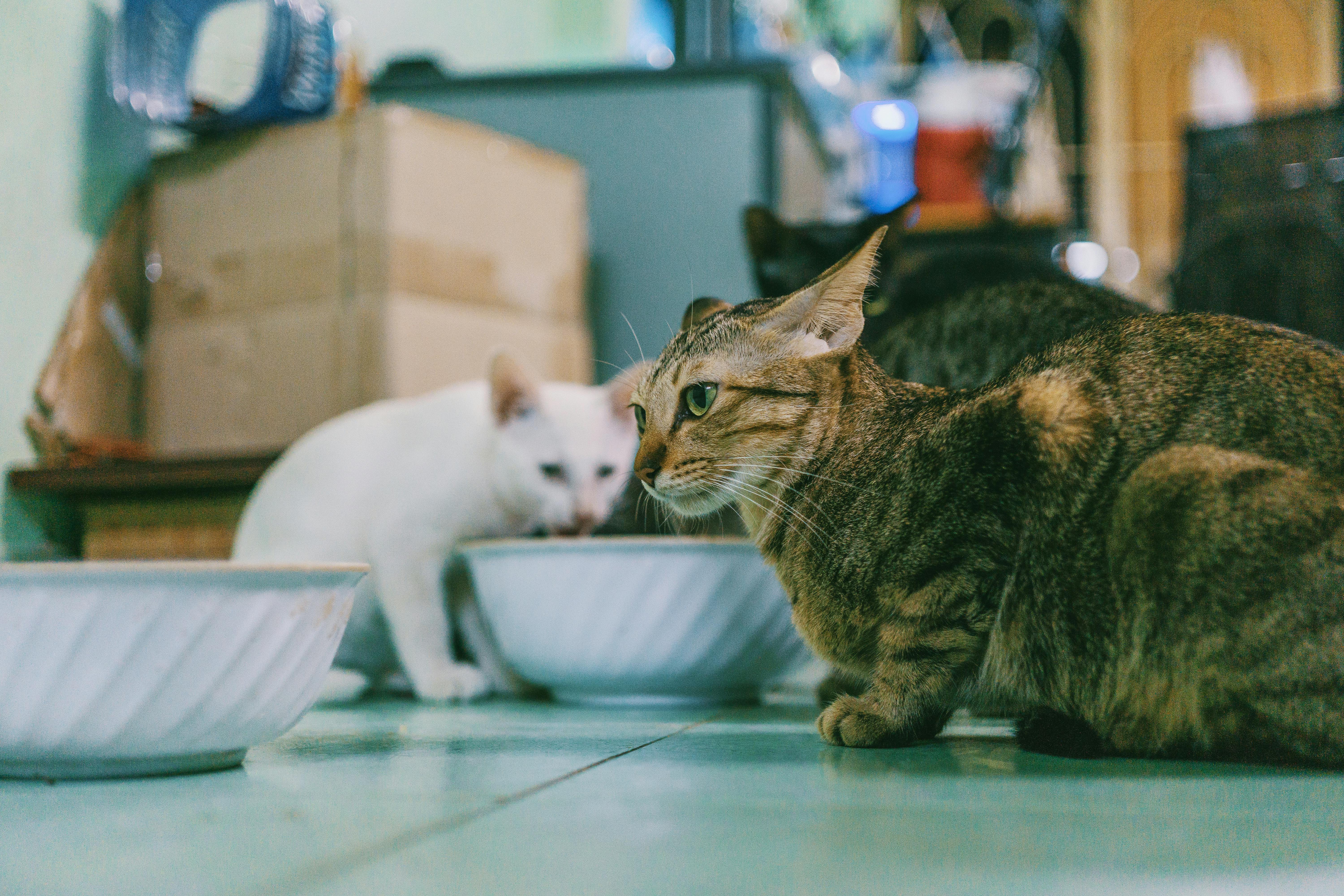
A household that has two or more cats is considered as a multi-cat household